: TEACHING-LEARNING STYLES: THE CONSTRUCTIVISM AND THEORY-BASED DIRECT INSTRUCTION
So hi , today i'm going to write about teaching - learning styles : the constructivism and theory based direct instruction. let me explain more !
“Modeling behavior you wish your students to reflect,”
How to model your behaviour?
Teaching involves much more than the imparting of knowledge to the children in a teacher's classroom. Beyond book know-how, youths need to be introduced to the various aspects of socialization and other interactions with their peers and teachers.
Constructivism is a learning theory of educational philosophy that many educators began to consider in the 1990s
One of the primary tenets of this philosophy is that leaners construct their own meaning from new information, as they interact with reality or others with different perspectives.
To use their prior knowledge and experiences to formulate new, related, and/or adaptiveconcepts in learning. Under this framework the role of the teacher becomes that of a facilitator, providing guidance so that learners can construct their own knowledge. Jonassen (1997) suggests ‘well-structured’ learning environment are useful for novice learners and that “ill-structured” environments are only useful for more advanced learners.
Founders of constructivism are :
John Dewey (student centered learning/character education/moral education/democracy)
Jean Piaget (Cognitive- stages of thinking poses and maturation e.g. preoperational stage, concrete operational stage, formal operational stage, metacognitive stage – thinking about thinking)
Maria Montessori (early childhood philosopher -children’s mind is like a sponge, it absorbs information and tries to make sense what is around them
Lev Vygotsky: Zone of Proximal Development: a phase a child can master a task if given appropriate help and support
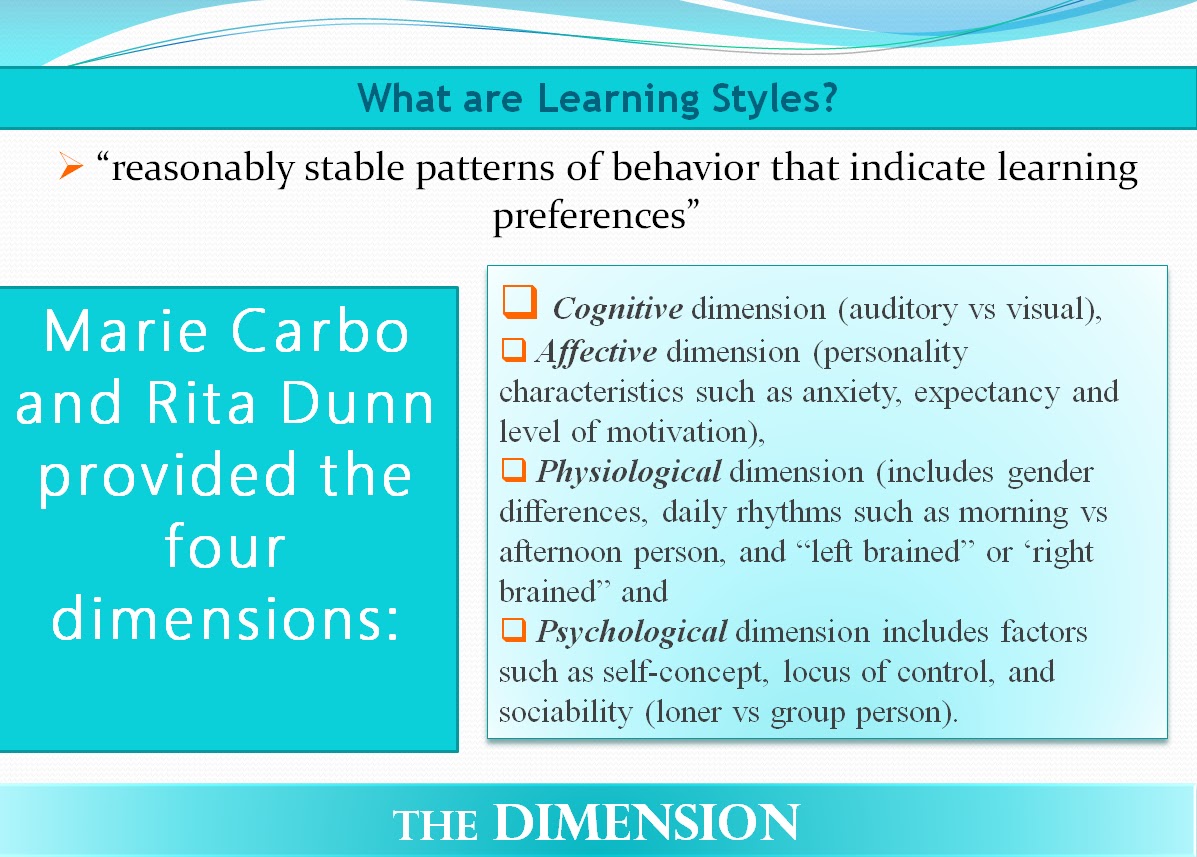
Active listening, authentic and situated learning, bridging, scaffolding, communities of learners, reflection.
DISTAR: (special for slow/special education students) Direct instruction system for teaching and learning. Find out what children need to know to succeed in school, teach it to them following principles of learning theory, its concept is –every child is not left behind, its concept is teacher proof- any teacher can use it and obtain same result, carefully structured, highly verbal, patterned drill and practice.
What is constructivism?
In the classroom, the constructivist view of learning can point towards a number of different teaching practices. In the most general sense, it usually means encouraging students to use active techniques (experiments, real-world problem solving) to create more knowledge and then to reflect on and talk about what they are doing and how their understanding is changing. The teacher makes sure she understands the students' preexisting conceptions, and guides the activity to address them and then build on them.
Constructivist teachers encourage students to constantly assess how the activity is helping them gain understanding. By questioning themselves and their strategies, students in the constructivist classroom ideally become "expert learners." This gives them ever-broadening tools to keep learning. With a well-planned classroom environment, the students learn HOW TO LEARN.
You might look at it as a spiral. When they continuously reflect on their experiences, students find their ideas gaining in complexity and power, and they develop increasingly strong abilities to integrate new information. One of the teacher's main roles becomes to encourage this learning and reflection process.
For example: Groups of students in a science class are discussing a problem in physics. Though the teacher knows the "answer" to the problem, she focuses on helping students restate their questions in useful ways. She prompts each student to reflect on and examine his or her current knowledge. When one of the students comes up with the relevant concept, the teacher seizes upon it, and indicates to the group that this might be a fruitful avenue for them to explore. They design and perform relevant experiments. Afterward, the students and teacher talk about what they have learned, and how their observations and experiments helped (or did not help) them to better understand the concept.
Contrary to criticisms by some (conservative/traditional) educators, constructivism does not dismiss the active role of the teacher or the value of expert knowledge. Constructivism modifies that role, so that teachers help students to construct knowledge rather than to reproduce a series of facts. The constructivist teacher provides tools such as problem-solving and inquiry-based learning activities with which students formulate and test their ideas, draw conclusions and inferences, and pool and convey their knowledge in a collaborative learning environment. Constructivism transforms the student from a passive recipient of information to an active participant in the learning process. Always guided by the teacher, students construct their knowledge actively rather than just mechanically ingesting knowledge from the teacher or the textbook.
Constructivism is also often misconstrued as a learning theory that compels students to "reinvent the wheel." In fact, constructivism taps into and triggers the student's innate curiosity about the world and how things work. Students do not reinvent the wheel but, rather, attempt to understand how it turns, how it functions. They become engaged by applying their existing knowledge and real-world experience, learning to hypothesize, testing their theories, and ultimately drawing conclusions from their findings.
The best way for you to really understand what constructivism is and what it means in your classroom is by seeing examples of it at work, speaking with others about it, and trying it yourself. As you progress through each segment of this workshop, keep in mind questions or ideas to share with your colleagues.
Constructivism
How does this theory differ from traditional ideas about teaching and learning?
As with many of the methods addressed in this series of workshops, in the constructivist classroom, the focus tends to shift from the teacher to the students. The classroom is no longer a place where the teacher ("expert") pours knowledge into passive students, who wait like empty vessels to be filled. In the constructivist model, the students are urged to be actively involved in their own process of learning. The teacher functions more as a facilitator who coaches, mediates, prompts, and helps students develop and assess their understanding, and thereby their learning. One of the teacher's biggest jobs becomes ASKING GOOD QUESTIONS.
And, in the constructivist classroom, both teacher and students think of knowledge not as inert factoids to be memorized, but as a dynamic, ever-changing view of the world we live in and the ability to successfully stretch and explore that view.
The chart below compares the traditional classroom to the constructivist one. You can see significant differences in basic assumptions about knowledge, students, and learning. (It's important, however, to bear in mind that constructivists acknowledge that students are constructing knowledge in traditional classrooms, too. It's really a matter of the emphasis being on the student, not on the instructor.)
In a constructivist classroom, learning is . . .
Students are not blank slates upon which knowledge is etched. They come to learning situations with already formulated knowledge, ideas, and understandings. This previous knowledge is the raw material for the new knowledge they will create.
Example: An elementary school teacher presents a class problem to measure the length of the "Mayflower." Rather than starting the problem by introducing the ruler, the teacher allows students to reflect and to construct their own methods of measurement. One student offers the knowledge that a doctor said he is four feet tall. Another says she knows horses are measured in "hands." The students discuss these and other methods they have heard about, and decide on one to apply to the problem.
The student is the person who creates new understanding for him/herself. The teacher coaches, moderates, suggests, but allows the students room to experiment, ask questions, try things that don't work. Learning activities require the students' full participation (like hands-on experiments). An important part of the learning process is that students reflect on, and talk about, their activities. Students also help set their own goals and means of assessment.
Examples: A middle-school language arts teacher sets aside time each week for a writing lab. The emphasis is on content and getting ideas down rather than memorizing grammatical rules, though one of the teacher's concerns is the ability of his students to express themselves well through written language. The teacher provides opportunities for students to examine the finished and earlier drafts of various authors. He allows students to select and create projects within the general requirement of building a portfolio 1. Students serve as peer editors who value originality and uniqueness rather than the best way to fulfill an assignment.
1.
In a history class, asking students to read and think about different versions of and perspectives on "history" can lead to interesting discussions. Is history as taught in textbooks accurate? Are there different versions of the same history? Whose version of history is most accurate? How do we know? From there, students can make their own judgments.
Students control their own learning process, and they lead the way by reflecting on their experiences. This process makes them experts of their own learning. The teacher helps create situations where the students feel safe questioning and reflecting on their own processes, either privately or in group discussions. The teacher should also create activities that lead the student to reflect on his or her prior knowledge and experiences. Talking about what was learned and how it was learned is really important.
Example: Students keep journals in a writing class where they record how they felt about the class projects, the visual and verbal reactions of others to the project, and how they felt their own writing had changed. Periodically the teacher reads these journals and holds a conference with the student where the two assess (1) what new knowledge the student has created, (2) how the student learns best, and (3) the learning environment and the teacher's role in it.
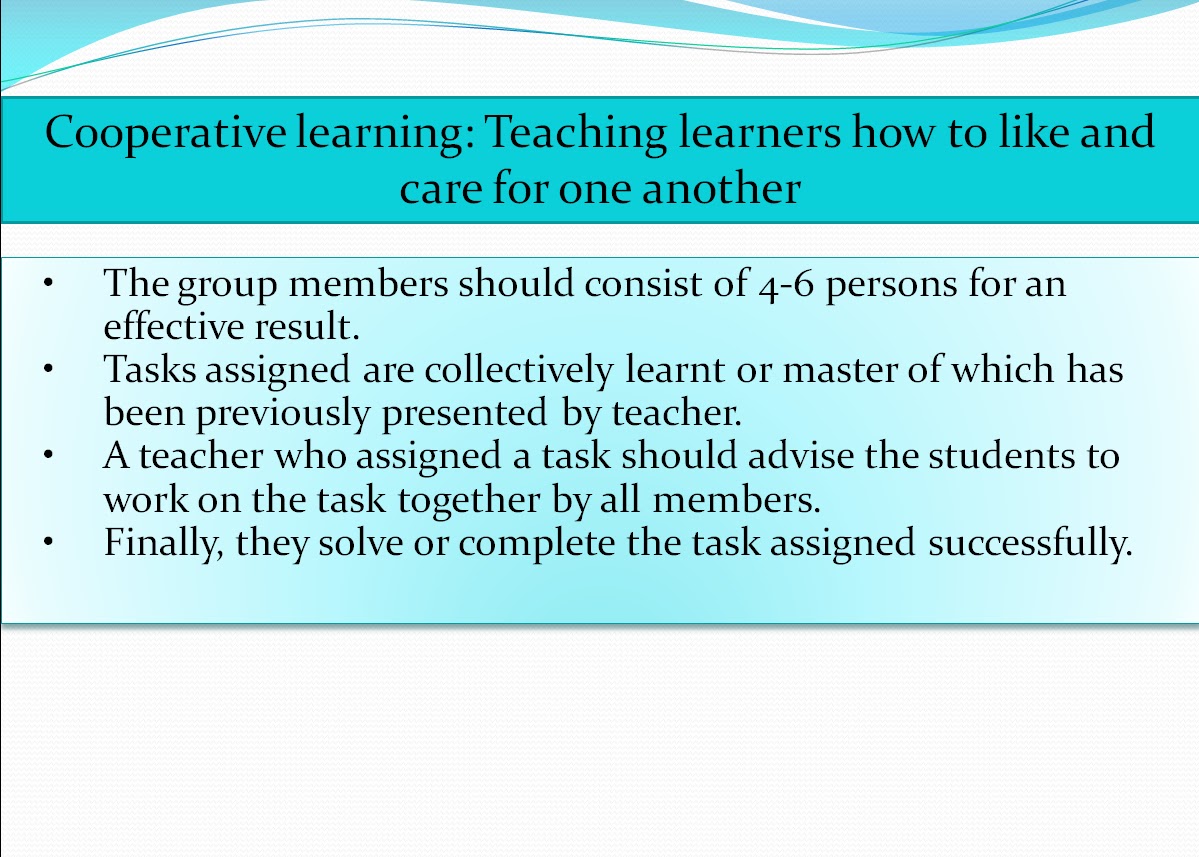
The constructivist classroom relies heavily on collaboration among students. There are many reasons why collaboration contributes to learning. The main reason it is used so much in constructivism is that students learn about learning not only from themselves, but also from their peers. When students review and reflect on their learning processes together, they can pick up strategies and methods from one another.
Example: In the course of studying ancient civilizations, students undertake an archaeological dig. This may be something constructed in a large sandbox, or, as in the Dalton School's "Archaeotype" software simulation, on a computer. As the students find different objects, the teacher introduces classifying techniques. The students are encouraged to (1) set up a group museum by developing criteria and choosing which objects should belong, and (2) collaborate with other students who worked in different quadrants of the dig. Each group is then asked to develop theories about the civilizations that inhabited the area.
The main activity in a constructivist classroom is solving problems. Students use inquiry methods to ask questions, investigate a topic, and use a variety of resources to find solutions and answers. As students explore the topic, they draw conclusions, and, as exploration continues, they revisit those conclusions. Exploration of questions leads to more questions. (See the CONCEPT TO CLASSROOM workshop Inquiry-based Learning)
Example: Sixth graders figuring out how to purify water investigate solutions ranging from coffee-filter paper, to a stove-top distillation apparatus, to piles of charcoal, to an abstract mathematical solution based on the size of a water molecule. Depending upon students' responses, the teacher encourages abstract as well as concrete, poetic as well as practical, creations of new knowledge.
Students have ideas that they may later see were invalid, incorrect, or insufficient to explain new experiences. These ideas are temporary steps in the integration of knowledge. For instance, a child may believe that all trees lose their leaves in the fall, until she visits an evergreen forest. Constructivist teaching takes into account students' current conceptions and builds from there.
What happens when a student gets a new piece of information? The constructivist model says that the student compares the information to the knowledge and understanding he/she already has, and one of three things can occur:
Example: An elementary teacher believes her students are ready to study gravity. She creates an environment of discovery with objects of varying kinds. Students explore the differences in weight among similarly sized blocks of Styrofoam, wood, and lead. Some students hold the notion that heavier objects fall faster than light ones. The teacher provides materials (stories, posters, and videos) about Galileo, Newton, etc. She leads a discussion on theories about falling. The students then replicate Galileo's experiment by dropping objects of different weights and measuring how fast they fall. They see that objects of different weights actually usually fall at the same speed, although surface area and aerodynamic properties can affect the rate of fall.
And, in the constructivist classroom, both teacher and students think of knowledge not as inert factoids to be memorized, but as a dynamic, ever-changing view of the world we live in and the ability to successfully stretch and explore that view.
The chart below compares the traditional classroom to the constructivist one. You can see significant differences in basic assumptions about knowledge, students, and learning. (It's important, however, to bear in mind that constructivists acknowledge that students are constructing knowledge in traditional classrooms, too. It's really a matter of the emphasis being on the student, not on the instructor.)
 |  |
| Curriculum begins with the parts of the whole. Emphasizes basic skills. | Curriculum emphasizes big concepts, beginning with the whole and expanding to include the parts. |
| Strict adherence to fixed curriculum is highly valued. | Pursuit of student questions and interests is valued. |
| Materials are primarily textbooks and workbooks. | Materials include primary sources of material and manipulative materials. |
| Learning is based on repetition. | Learning is interactive, building on what the student already knows. |
| Teachers disseminate information to students; students are recipients of knowledge. | Teachers have a dialogue with students, helping students construct their own knowledge. |
| Teacher's role is directive, rooted in authority. | Teacher's role is interactive, rooted in negotiation. |
| Assessment is through testing, correct answers. | Assessment includes student works, observations, and points of view, as well as tests. Process is as important as product. |
| Knowledge is seen as inert. | Knowledge is seen as dynamic, ever changing with our experiences. |
| Students work primarily alone. |
Students work primarily in groups.
|
What does constructivism have to do with my classroom?
As is the case with many of the current/popular paradigms, you're probably already using the constructivist approach to some degree. Constructivist teachers pose questions and problems, then guide students to help them find their own answers. They use many techniques in the teaching process. For example, they may:- prompt students to formulate their own questions (inquiry)
- allow multiple interpretations and expressions of learning (multiple intelligences)
- encourage group work and the use of peers as resources (collaborative learning)
In a constructivist classroom, learning is . . .
Students are not blank slates upon which knowledge is etched. They come to learning situations with already formulated knowledge, ideas, and understandings. This previous knowledge is the raw material for the new knowledge they will create.
Example: An elementary school teacher presents a class problem to measure the length of the "Mayflower." Rather than starting the problem by introducing the ruler, the teacher allows students to reflect and to construct their own methods of measurement. One student offers the knowledge that a doctor said he is four feet tall. Another says she knows horses are measured in "hands." The students discuss these and other methods they have heard about, and decide on one to apply to the problem.
The student is the person who creates new understanding for him/herself. The teacher coaches, moderates, suggests, but allows the students room to experiment, ask questions, try things that don't work. Learning activities require the students' full participation (like hands-on experiments). An important part of the learning process is that students reflect on, and talk about, their activities. Students also help set their own goals and means of assessment.
Examples: A middle-school language arts teacher sets aside time each week for a writing lab. The emphasis is on content and getting ideas down rather than memorizing grammatical rules, though one of the teacher's concerns is the ability of his students to express themselves well through written language. The teacher provides opportunities for students to examine the finished and earlier drafts of various authors. He allows students to select and create projects within the general requirement of building a portfolio 1. Students serve as peer editors who value originality and uniqueness rather than the best way to fulfill an assignment.
1.
In a history class, asking students to read and think about different versions of and perspectives on "history" can lead to interesting discussions. Is history as taught in textbooks accurate? Are there different versions of the same history? Whose version of history is most accurate? How do we know? From there, students can make their own judgments.
Students control their own learning process, and they lead the way by reflecting on their experiences. This process makes them experts of their own learning. The teacher helps create situations where the students feel safe questioning and reflecting on their own processes, either privately or in group discussions. The teacher should also create activities that lead the student to reflect on his or her prior knowledge and experiences. Talking about what was learned and how it was learned is really important.
Example: Students keep journals in a writing class where they record how they felt about the class projects, the visual and verbal reactions of others to the project, and how they felt their own writing had changed. Periodically the teacher reads these journals and holds a conference with the student where the two assess (1) what new knowledge the student has created, (2) how the student learns best, and (3) the learning environment and the teacher's role in it.
The constructivist classroom relies heavily on collaboration among students. There are many reasons why collaboration contributes to learning. The main reason it is used so much in constructivism is that students learn about learning not only from themselves, but also from their peers. When students review and reflect on their learning processes together, they can pick up strategies and methods from one another.
Example: In the course of studying ancient civilizations, students undertake an archaeological dig. This may be something constructed in a large sandbox, or, as in the Dalton School's "Archaeotype" software simulation, on a computer. As the students find different objects, the teacher introduces classifying techniques. The students are encouraged to (1) set up a group museum by developing criteria and choosing which objects should belong, and (2) collaborate with other students who worked in different quadrants of the dig. Each group is then asked to develop theories about the civilizations that inhabited the area.
The main activity in a constructivist classroom is solving problems. Students use inquiry methods to ask questions, investigate a topic, and use a variety of resources to find solutions and answers. As students explore the topic, they draw conclusions, and, as exploration continues, they revisit those conclusions. Exploration of questions leads to more questions. (See the CONCEPT TO CLASSROOM workshop Inquiry-based Learning)
Example: Sixth graders figuring out how to purify water investigate solutions ranging from coffee-filter paper, to a stove-top distillation apparatus, to piles of charcoal, to an abstract mathematical solution based on the size of a water molecule. Depending upon students' responses, the teacher encourages abstract as well as concrete, poetic as well as practical, creations of new knowledge.
Students have ideas that they may later see were invalid, incorrect, or insufficient to explain new experiences. These ideas are temporary steps in the integration of knowledge. For instance, a child may believe that all trees lose their leaves in the fall, until she visits an evergreen forest. Constructivist teaching takes into account students' current conceptions and builds from there.
What happens when a student gets a new piece of information? The constructivist model says that the student compares the information to the knowledge and understanding he/she already has, and one of three things can occur:
- The new information matches up with his previous knowledge pretty well (it's consonant with the previous knowledge), so the student adds it to his understanding. It may take some work, but it's just a matter of finding the right fit, as with a puzzle piece.
- The information doesn't match previous knowledge (it's dissonant). The student has to change her previous understanding to find a fit for the information. This can be harder work.
- The information doesn't match previous knowledge, and it is ignored. Rejected bits of information may just not be absorbed by the student. Or they may float around, waiting for the day when the student's understanding has developed and permits a fit.